Overview
Component 2 of the Distributed Access through Renewable Energy Scale-up (DARES) Project is a $300 million initiative for making Stand Alone Solar (SAS) systems available and affordable for households, MSMEs, public institutions, and farmers in rural areas. The component focuses on improving energy access among rural and lower-income segments through strategic Result-Based Financing categorized into three distinct areas:
- • Solar Home Systems (Supply Side Subsidies)
- • Solar for Business Systems
- • Productive Use of Energy Technologies
These interventions are structured to reduce affordability barriers, strengthen private-sector participation, reduce reliance on fossil fuel generator and accelerate deployment of quality-assured stand-alone solar solutions across Nigeria.
Total funding available for the sub-component = US$100 million
The SHS sub-component is structured to reward successful deployments of solar technologies, ensuring effective and efficient implementation of the systems. The grants are designed to promote the deployment of SHSs across various scales for households and MSMEs in hard-to-reach or low-income segments. The program features:
Supply-side subsidies: These are designed to help off-grid energy access companies scale operations into hard-to-reach, unserved and underserved areas by providing a results based financial incentive for the deployment of solar home systems. The purpose is to bridge the energy access gap rural unserved and underserved Nigeria with Tier 1 and 2 solar solutions.
Interested applicants begin by registering via the REA-DARES Stand-Alone Solar portal to receive credentials to access the Odyssey platform where all programme documentation, guidelines, templates, and qualification requirements needed for participation in the SHS Supply-Side Subsidy are provided.
After submitting all required materials on Odyssey, applications undergo technical and administrative evaluation, followed by approvals or no-objection from the relevant authorities. Successful companies then execute a Grant Agreement with the REA, formally entering the SAS-SHS program.
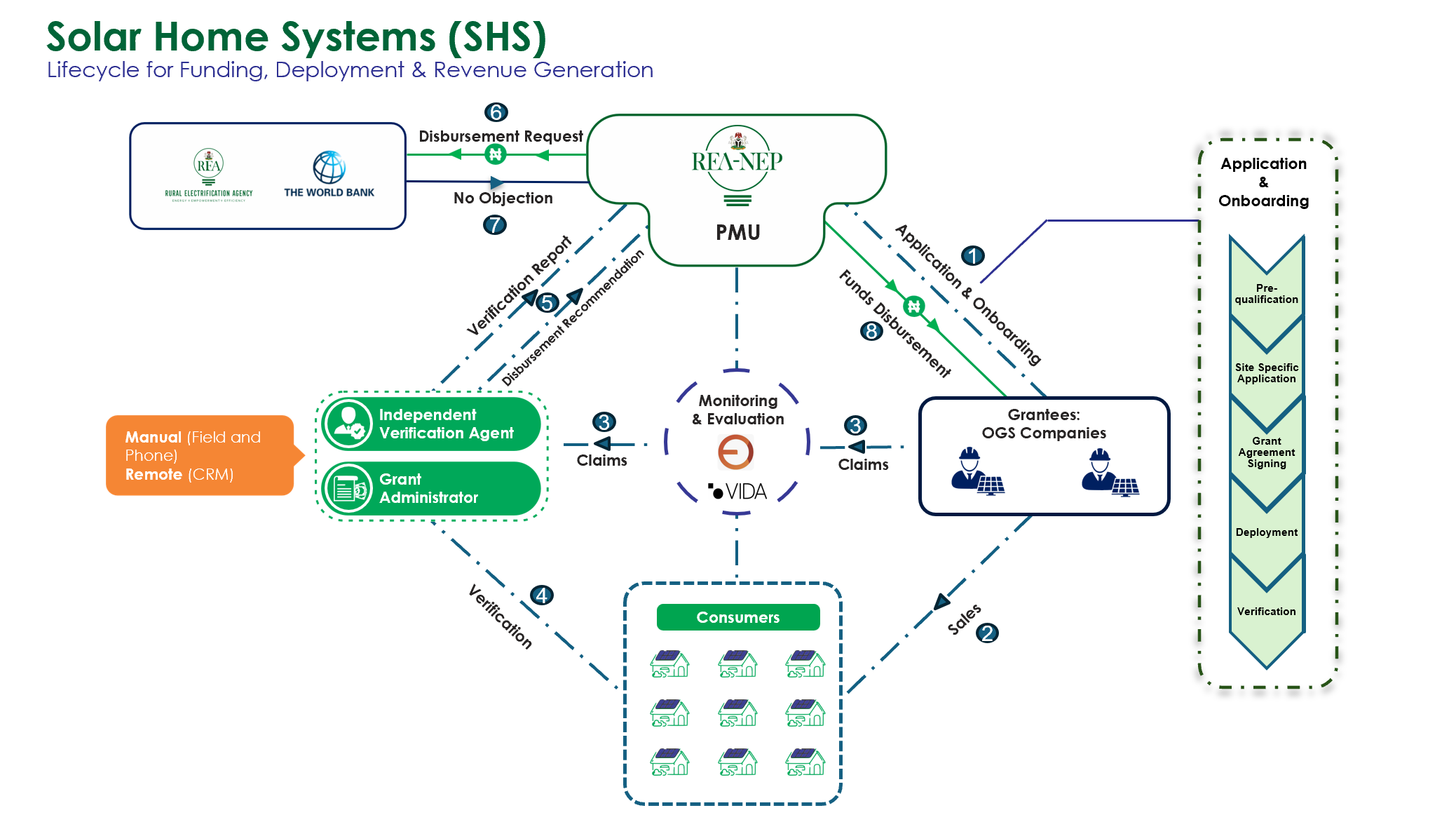
Lifecycle for Funding, Deployment & Revenue Generation:
- Application & Onboarding
- Sales of the Solar Home System by the OGS Companies to the Consumers
- OGS Companies submit deployment claims with a minimum of 100 systems per claim per month through the CRM, supported by system serial numbers, installation evidence, and remote monitoring data
- Claims are first reviewed internally for completeness and compliance before undergoing phone, field, and system-level verification conducted jointly by the Independent Verification Agent (IVA) and the Grant Administrator (GA)Disbursement Recommendation
- A disbursement recommendation is produced after this process for review and approval by the PMU and
- The Disbursement Request is sent to the REA and then to the Bank
- A No Objection is obtained from the bank
- After which, funds are disbursed to the company based on verified outcomes and the applicable subsidy structure.
| S/N | SUBJECT | CRITERION | EVIDENCE TO BE PROVIDED |
|---|---|---|---|
| 1. | Company Information |
|
|
|
|
||
|
|
||
|
|
||
| 2. | Financial Information |
|
|
| 3. | Customer Tracking and Value Chain |
|
|
| 4. | Operational scale |
|
|
| 5. | Experience and Skills |
|
|
| 6. | Quality Verification |
|
|
| 7. | Environmental and Social |
|
|
Total funding available for the sub-component = US$150 million
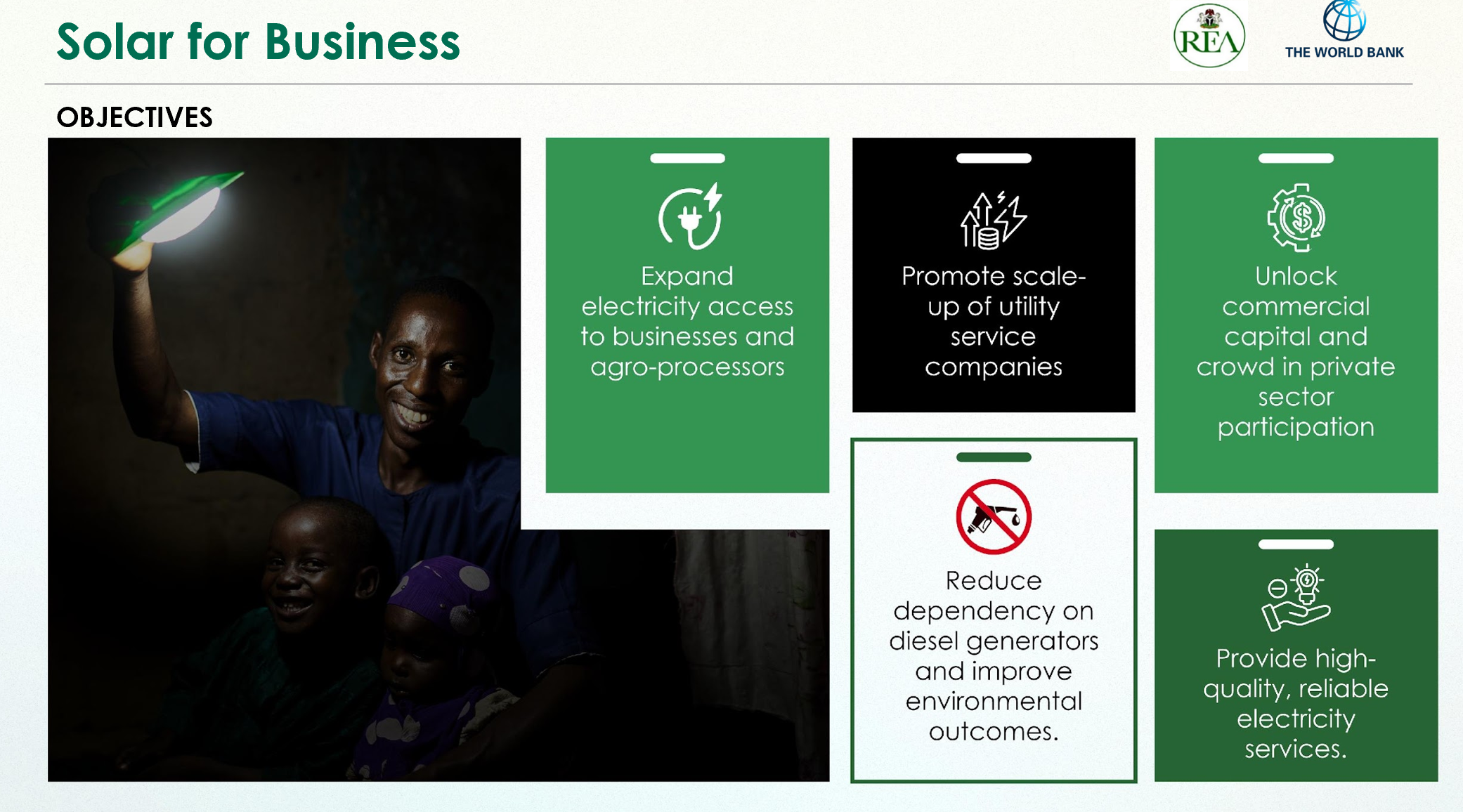
This sub-component focuses on the deployment of higher-capacity standalone solar systems tailored to meet the energy needs of specific productive entities such as economic hubs, MSME clusters, and agro-processor in peri-urban and rural areas. These solutions look to provide clean, reliable power to businesses that are heavily reliant on fossil fuel power generation sources. To address affordability and improve access, the program will introduce energy-as-a-service and long term lease to own models, which will cut out or minimize up-front costs allowing for power vending and payment over an agreed upon timeframe.
SFB TARGET SEGMENTS
Application and Qualification
- The Solar for Business targets MSMES clusters and Economic Hubs such as markets, plazas, and business centres using 1-10kVA solar systems.
Grant Agreement Signing
- Agro-Processing Zones such as Farms and Processing facilities requiring 1-100kVA systems.
Interested developers begin by registering through the REA-DARES Stand-Alone Solar portal to obtain credentials for the Odyssey platform, where all programme guidelines, eligibility criteria, system-sizing rules, and benchmark pricing for the Solar for Business (SFB) window are provided.
Developers proceed to identify and validate MSME clusters or agro-processing zones, conduct energy audits, determine system sizes approved under the programme (1-10 kVA for MSMEs and up to 100 kVA for agro-processing), and compile required documentation for submission. All applications undergo technical and commercial evaluation, followed by approvals or no-objection from the relevant authorities. Successful developers sign a Grant Agreement with the REA, formally commencing participation in the SFB window. During implementation, developers install approved systems equipped with IoT-enabled remote monitoring, vending functionality, and GPS tagging, ensuring compliance with the program's technical and clustering requirements.
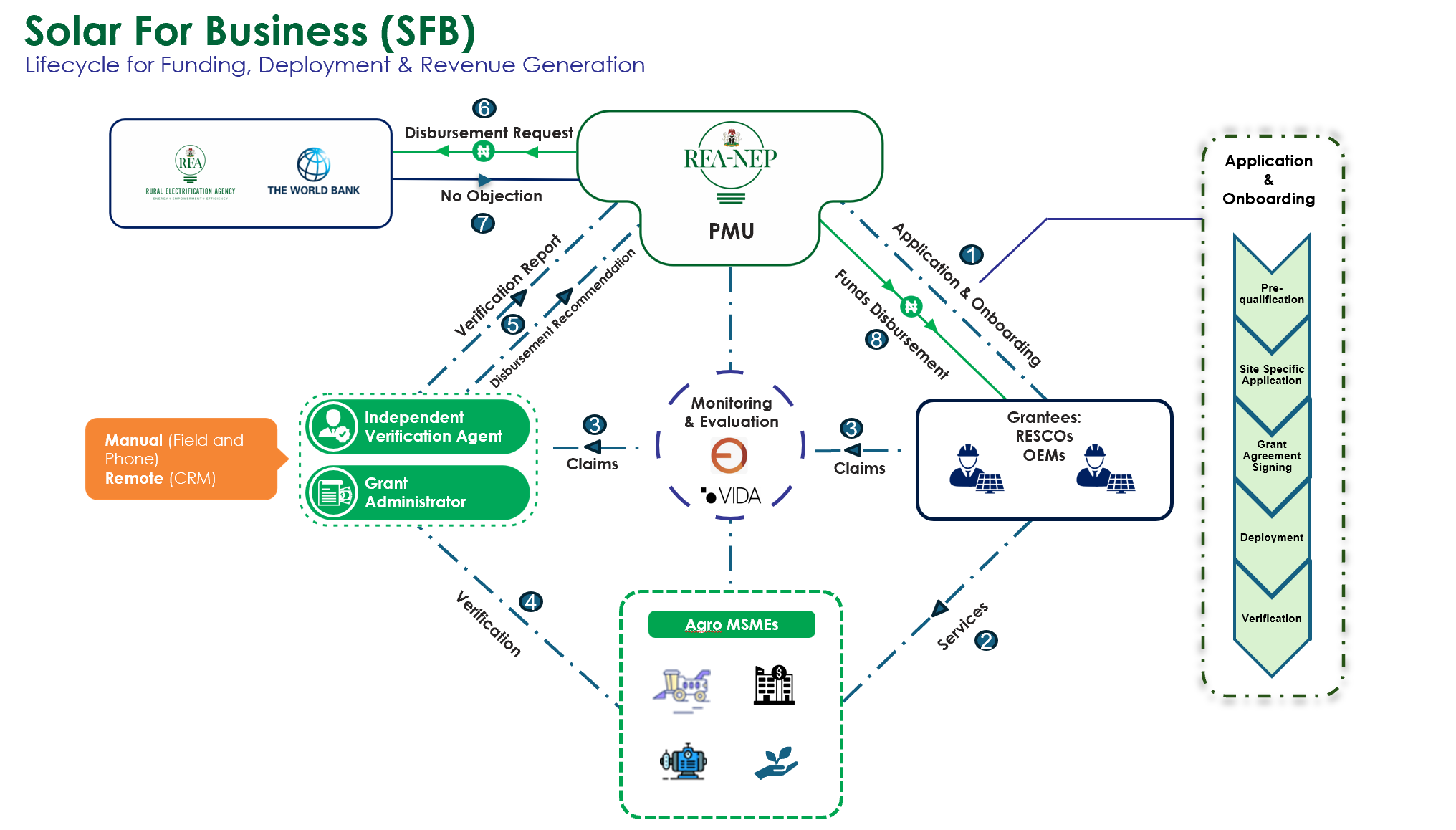
Lifecycle for Funding, Deployment & Revenue Generation:
- Application & Onboarding
- Provision of services by RESCOs to MSMEs and Agro-processing zones
- The RESCOs submit deployment claims through the CRM, supported by system serial numbers, installation evidence, and remote monitoring data
- Claims are first reviewed internally for completeness and compliance before undergoing phone, field, and system-level verification conducted jointly by the Independent Verification Agent (IVA) and the Grant Administrator (GA)Disbursement Recommendation
- A disbursement recommendation is produced after this process for review and approval by the PMU and
- The Disbursement Request is sent to the REA and then to the Bank
- A No Objection is obtained from the bank
- After which, funds are disbursed to the company based on verified outcomes and the applicable subsidy structure.
Total funding available for the sub-component = US$50 million
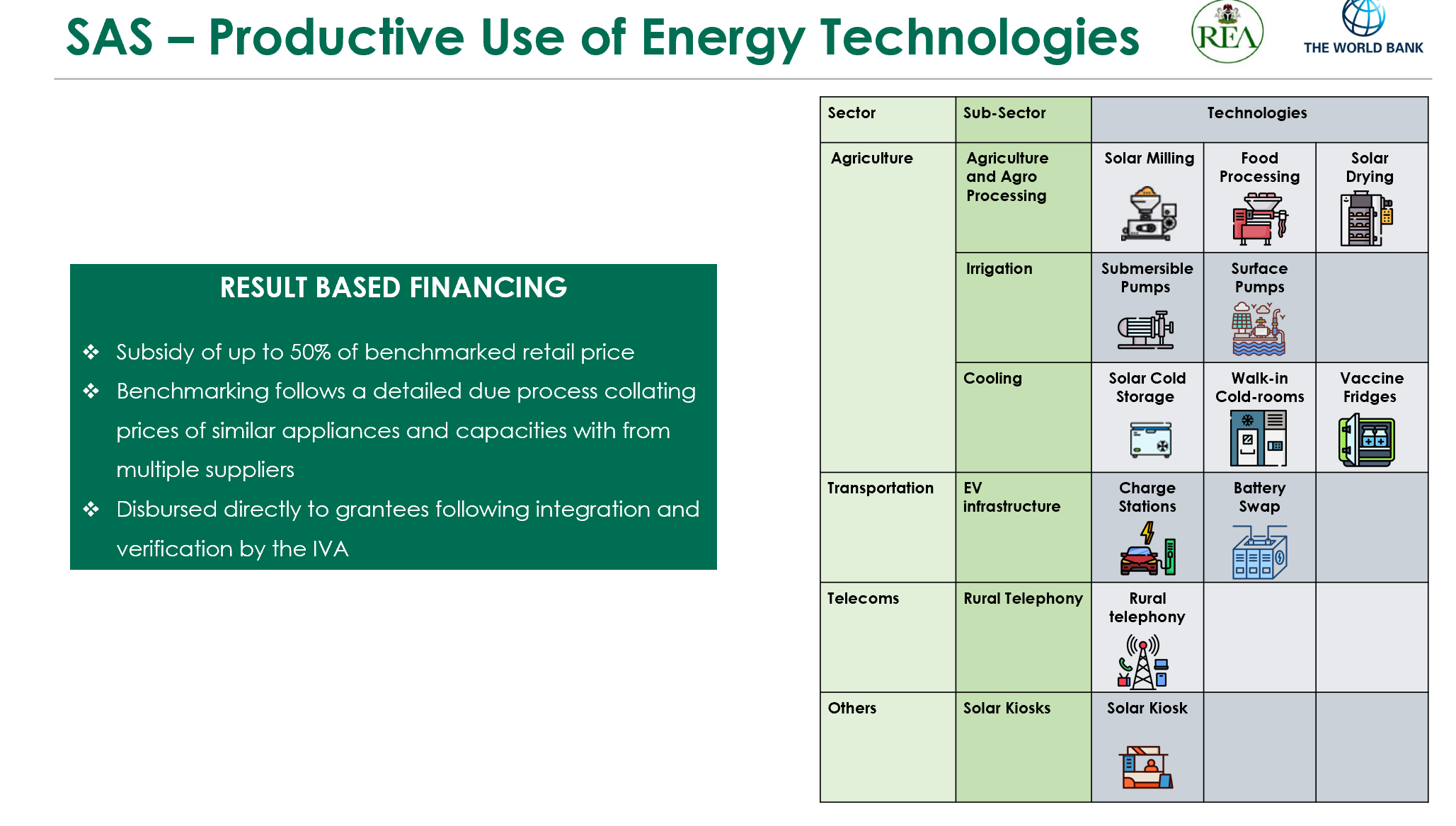
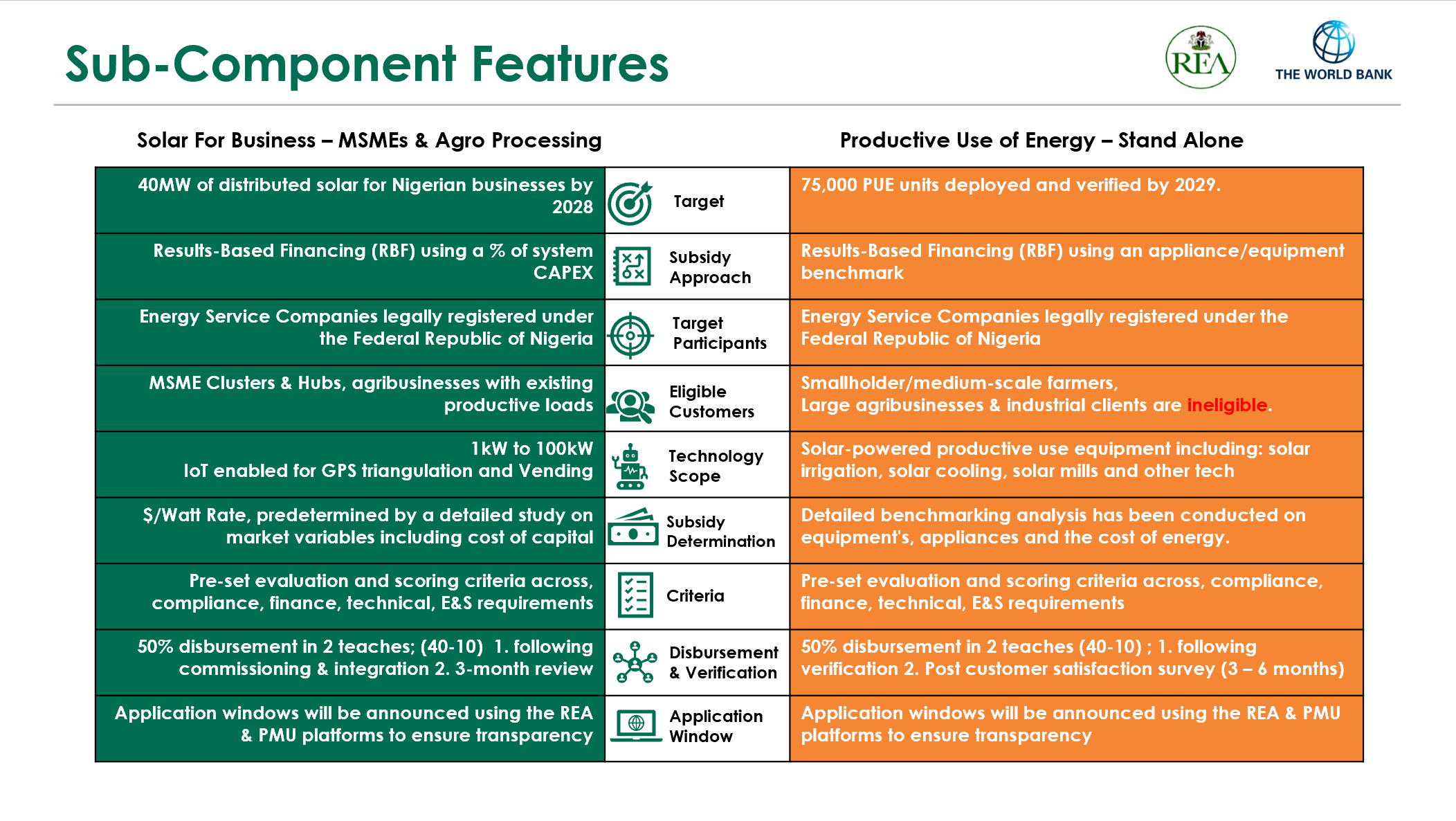
The Productive Use of Energy (PUE) subcomponent aims to improve the affordability and accessibility of high-quality solar-powered equipment and appliances that enhance productivity, support income generation, and stimulate economic activity for small holder farmers and MSMEs. The window prioritizes mature, market-ready technologies, such as solar irrigation solar cooling, processing, communications/telephony and electric mobility infrastructure. This subcomponent will be implemented with a results based financing model, the PMU has benchmarked the cost of these productive use equipment’s and appliances to predetermine costing, subsidies will be percentages of the benchmark costs.
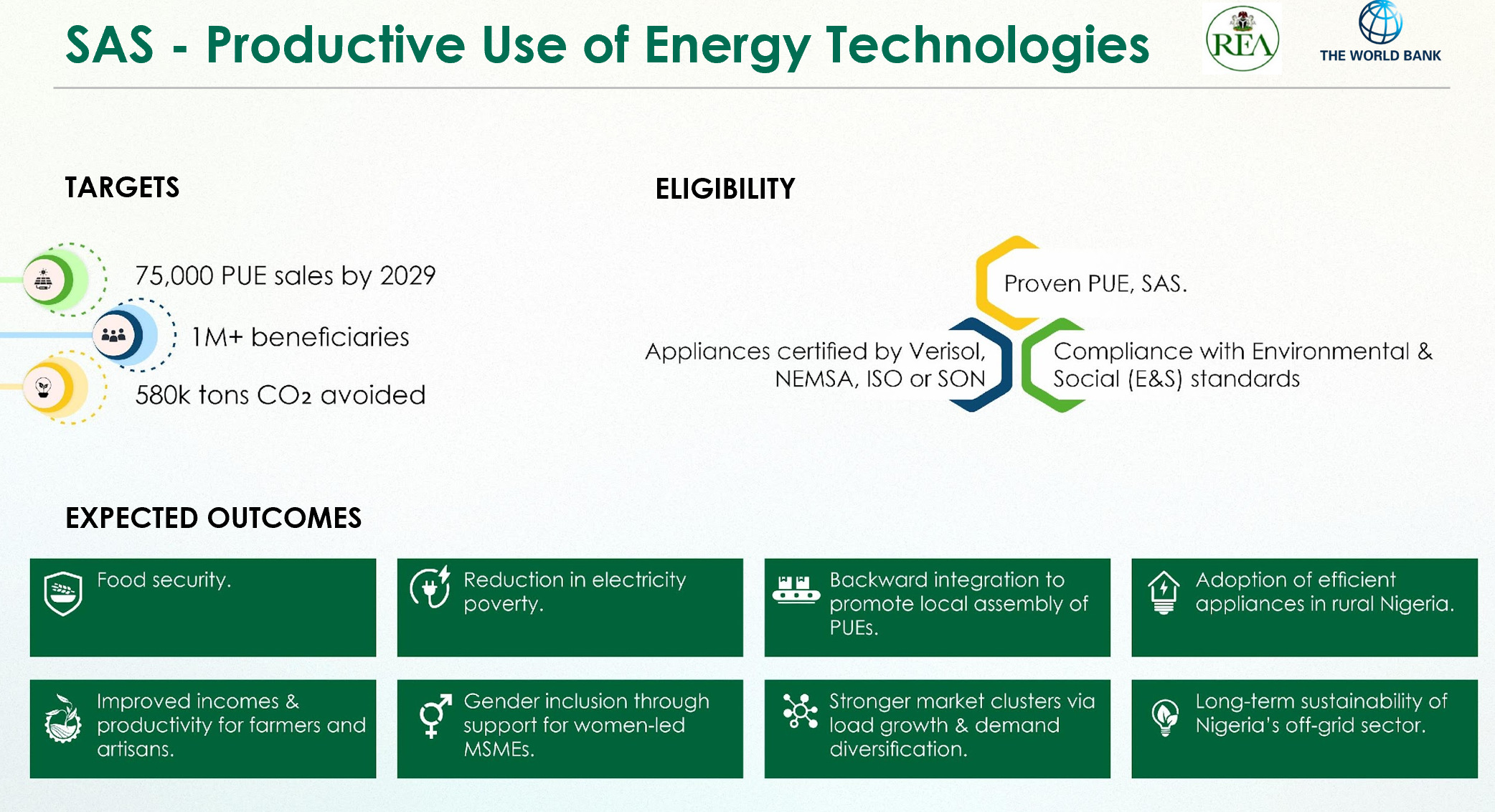
Program Scope & Eligible Technologies
To ensure sustainability and high development impact, the program is being rolled out in phases, beginning with mature technologies that have established market demand and clear productivity gains.
Applicable Technologies
These technologies are selected based on strong market activity, high potential for income generation, and availability of quality assurance frameworks. They include:
Agro-Processing
- Milling machines
- Grinding machines
Agricultural Irrigation
- Solar surface pumps
- Solar submersible pumps
Cold Storage Solutions
- Solar cold rooms
- Solar freezers
Electric Mobility Infrastructure
- EV charging stations
- Battery swap technology for 2 and 3 wheelers
Emerging Technologies
- Solar Kiosks
- Rural Telephony
These technologies will undergo further quality validation and market readiness assessments before widespread deployment.
Interested applicants begin by registering via the REA-DARES Stand-Alone Solar portal to obtain Odyssey platform access, where all guidelines, eligibility criteria, benchmark pricing, and application templates for the Productive Use of Energy (PUE) window are provided.
Applicants then prepare and submit proposals in line with the programme's quality assurance, certification requirements, and subsidy framework. Submissions are evaluated for technical compliance, pricing alignment, and consistency with PUE objectives. Once approvals or no-objection are secured, successful applicants execute a Grant Agreement with the REA, formally onboarding them into the PUE window. During deployment, companies must install only certified, pre-approved appliances integrated with smart inverters and remote monitoring systems.
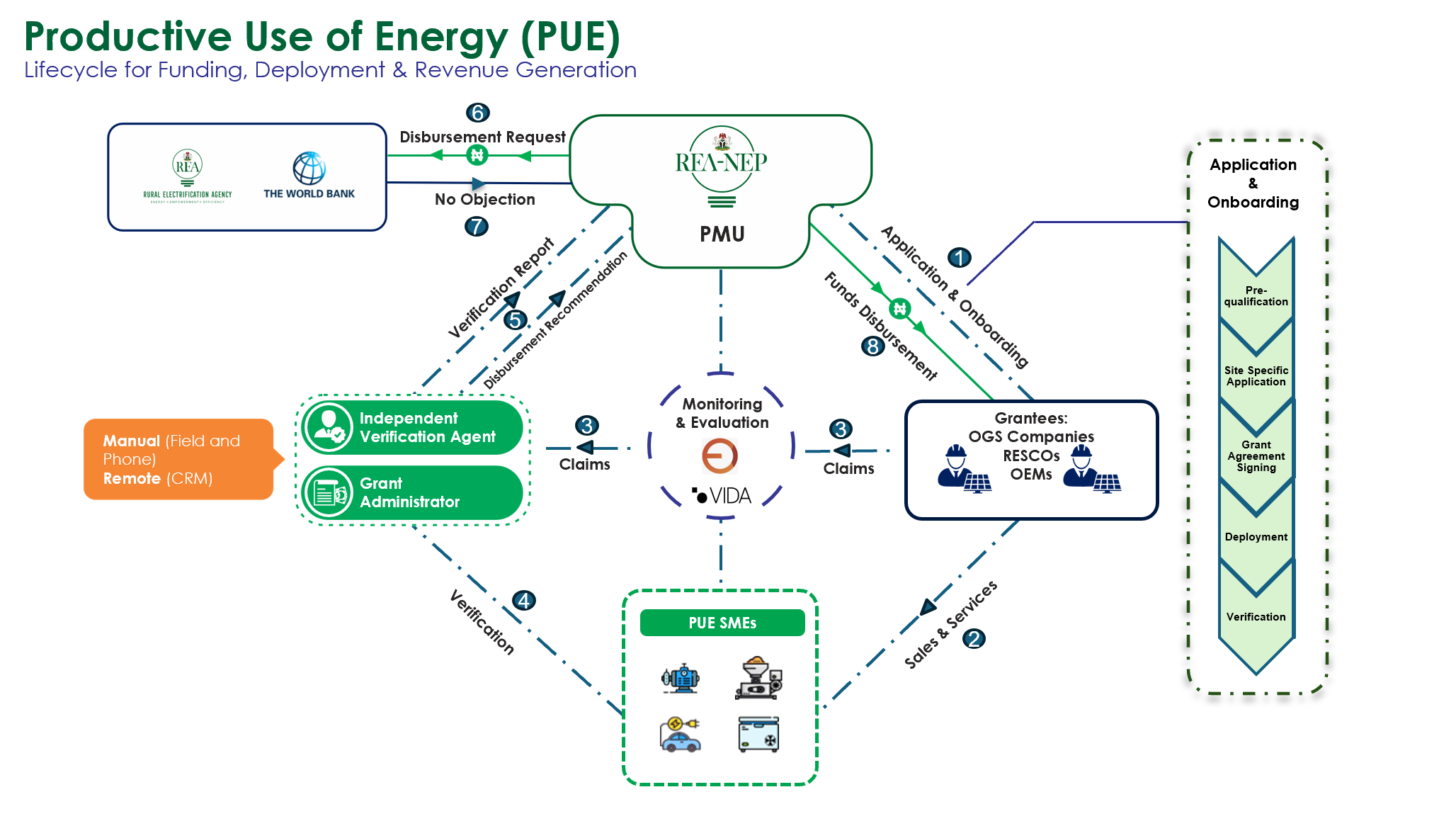
Lifecycle for Funding, Deployment & Revenue Generation:
- Application & Onboarding
- Sales of PUE units by the OGS Companies to the PUE SMEs
- OGS Companies submit deployment claims through the CRM, supported by system serial numbers, installation evidence, and remote monitoring data
- Claims are first reviewed internally for completeness and compliance before undergoing phone, field, and system-level verification conducted jointly by the Independent Verification Agent (IVA) and the Grant Administrator (GA)Disbursement Recommendation
- A disbursement recommendation is produced after this process for review and approval by the PMU and
- The Disbursement Request is sent to the REA and then to the Bank
- A No Objection is obtained from the bank
- After which, funds are disbursed to the company based on verified outcomes and the applicable subsidy structure.
Primary Verification

Independent Verification Agent
- Independently conduct phone and field verifications on claims submitted by grantees
- Report and follow up on grievances that may be discovered during the course of verification

Independent Verification Agent
- Online mode of verification, through GPS triangulation and system interconnectivity or monitoring of payment data received through the Customer Relationship Management (CRM) Tool
Secondary Verification

Periodic Audits by Internal and External Auditors

Impact Assessment surveys by M&E Specialist

Random Spot Checks and Testimonials

Odyssey Verification
- Applicable to systems which have CRM linked to the odyssey platform, real-time verification of submitted claims will be carried out by the Grant Administrator

Phone Verification
- Applicable to meters with APIs linked with Odyssey, as well as meters not linked;
- Customers are contacted via phone and interviewed by the IVA to determine to verify meter connections


Field Verification
- IVA visits sites to verify claim submitted by a developer